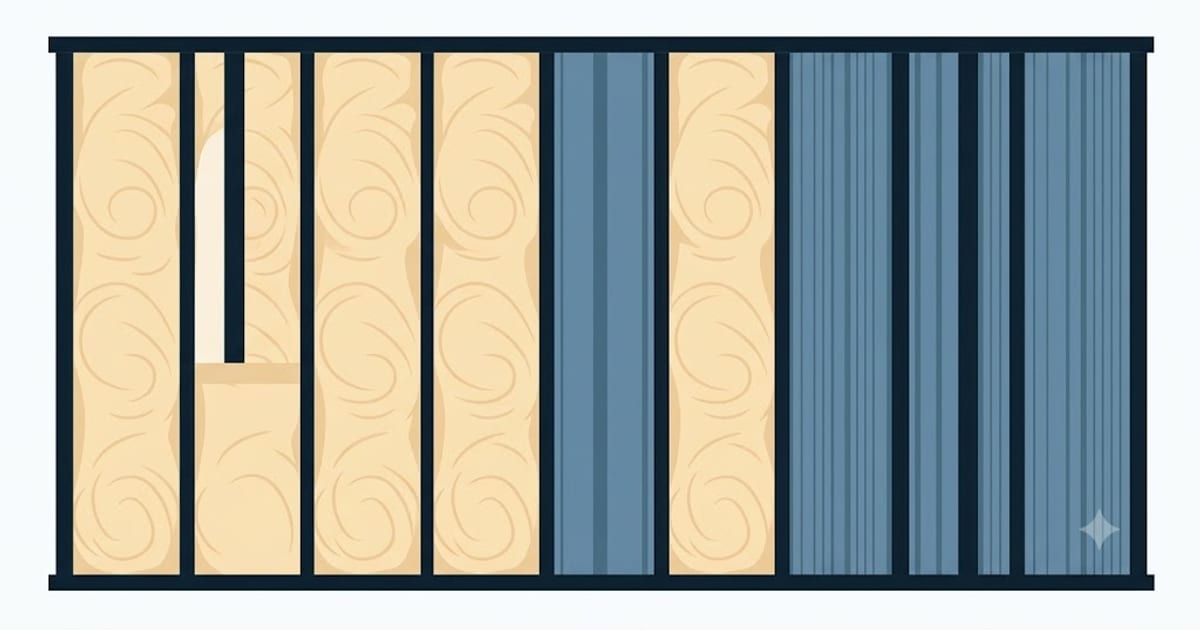
The cavity comparison is straightforward:
| Cavity depth | Typical batt | |
|---|---|---|
| 2×4 | 3½ in | R-13 to R-15 |
| 2×6 | 5½ in | R-19 to R-21 |
Call it R-15 against R-21 — a gain of six. That is the number people compare, and it is not the number the wall delivers.
The studs do not improve
Wood insulates at roughly R-1.25 per inch. A 2×6 stud is 5½ inches, so it is about R-6.9. The cavity beside it is R-21.
Heat takes the easy path. Every stud, plate, header, corner and cripple is a bypass around the insulation — thermal bridging.
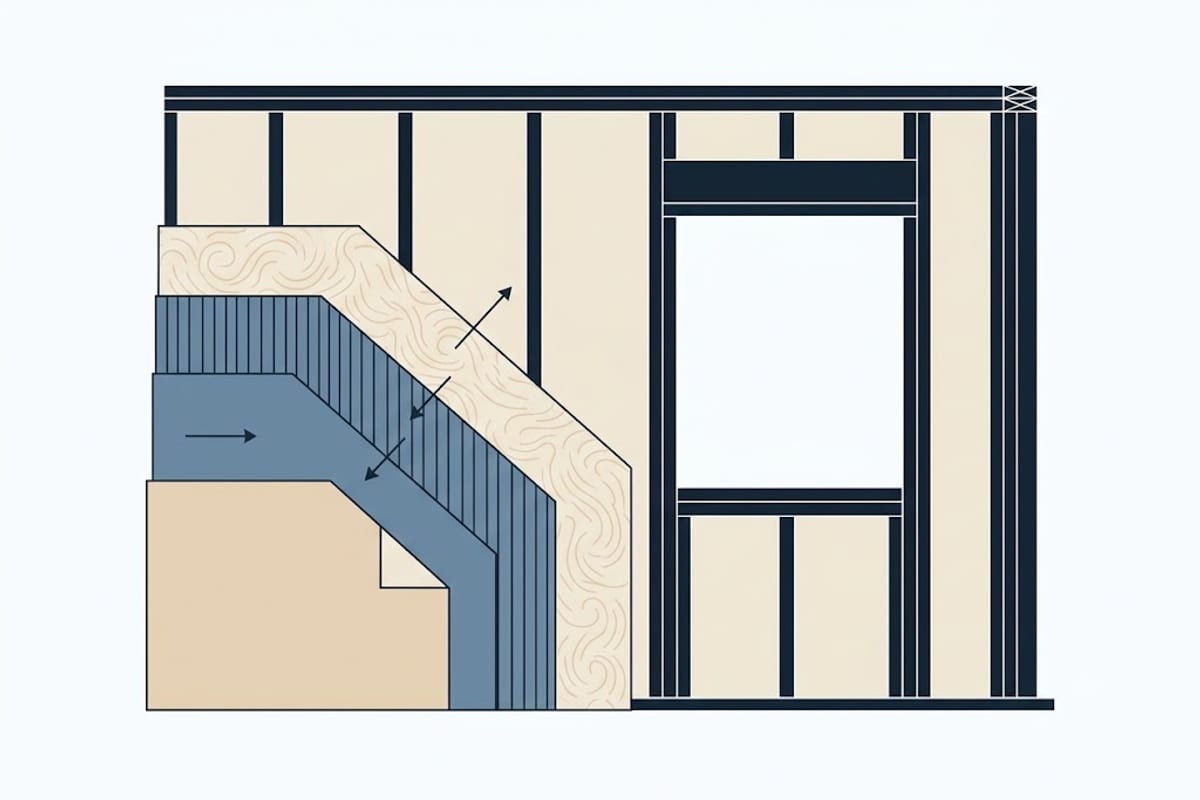
And there is far more framing than people picture. Once you count the double top plate, bottom plate, corners, window and door framing, headers and cripples, typical construction runs around 25% framing by area. Some framing-heavy walls are worse.
What the wall actually achieves
Averaging cavity and framing across the wall area:
| Wall | Cavity | Whole-wall, approximately |
|---|---|---|
| 2×4, R-13 | R-13 | R-9 to R-11 |
| 2×6, R-21 | R-21 | R-15 to R-17 |
So the cavity improves by 8 and the wall improves by about 5. That is the real answer to the comparison, and it is why "whole-wall R-value" is the term that matters.
The gap widens as cavity insulation gets better. Fill a 2×6 with closed-cell foam at R-33 and the studs still sit at R-6.9 — you have made the cavity excellent and left a quarter of the wall unchanged. Beyond a point, adding R inside the cavity buys progressively less.
Continuous exterior insulation is the fix
Rigid board on the outside of the framing covers everything — studs included. There is no bypass because there is no interruption.
An inch of XPS adds roughly R-5 to the entire wall area, not just the cavity. Compare:
- 2×4 with R-13 cavity: whole-wall ≈ R-10
- 2×4 with R-13 cavity + 1 in continuous: whole-wall ≈ R-15
- 2×6 with R-21 cavity: whole-wall ≈ R-16
A 2×4 wall with an inch of exterior foam roughly matches a 2×6 wall with none — using less lumber and a thinner wall. This is why modern energy codes are written as "R-20 cavity, or R-13 plus R-5 continuous": the two are treated as equivalent because in whole-wall terms they are.
Choosing polyiso for that layer needs care in cold climates, since its R-value falls with temperature — see R-value per inch.
Choosing
Building new: 2×6 is standard in most of North America and generally the right default. Whether you add continuous insulation depends on your climate zone and code, and it is the higher-value addition of the two if budget forces a choice.
Renovating an existing 2×4 wall: do not deepen the framing. Either use a higher-density cavity insulation — R-15 mineral wool in the same 3½ inches — or add exterior insulation when the siding comes off. Re-siding is the moment when continuous insulation is cheap; at any other time it is not.
Do not compress a batt to fit. An R-19 batt squashed into a 3½-inch cavity does not deliver R-19, or anything close. Buy the batt made for the depth.
The related trap — a correctly filled cavity around wiring and boxes — is covered in R-value for exterior walls.
FAQ
What is the R-value of a 2x6 wall?
The cavity holds R-19 to R-21, but the whole wall achieves about R-15 to R-17 once thermal bridging through the studs is counted.
Is a 2x6 wall worth it over a 2x4?
It gains roughly R-5 to R-6 in whole-wall terms. An inch of continuous exterior insulation on a 2×4 wall achieves about the same for less lumber.
What is thermal bridging?
Heat bypassing the insulation through solid framing. Wood is about R-1.25 per inch, so studs are far worse insulators than the cavity beside them.
How much of a wall is framing?
Around 25% by area in typical construction once plates, corners, headers and window framing are counted.
Can I put R-19 in a 2x4 wall?
No. It will not fit without compression, and compressed fiberglass loses much of its R-value. Use a high-density R-15 batt made for a 3½-inch cavity.