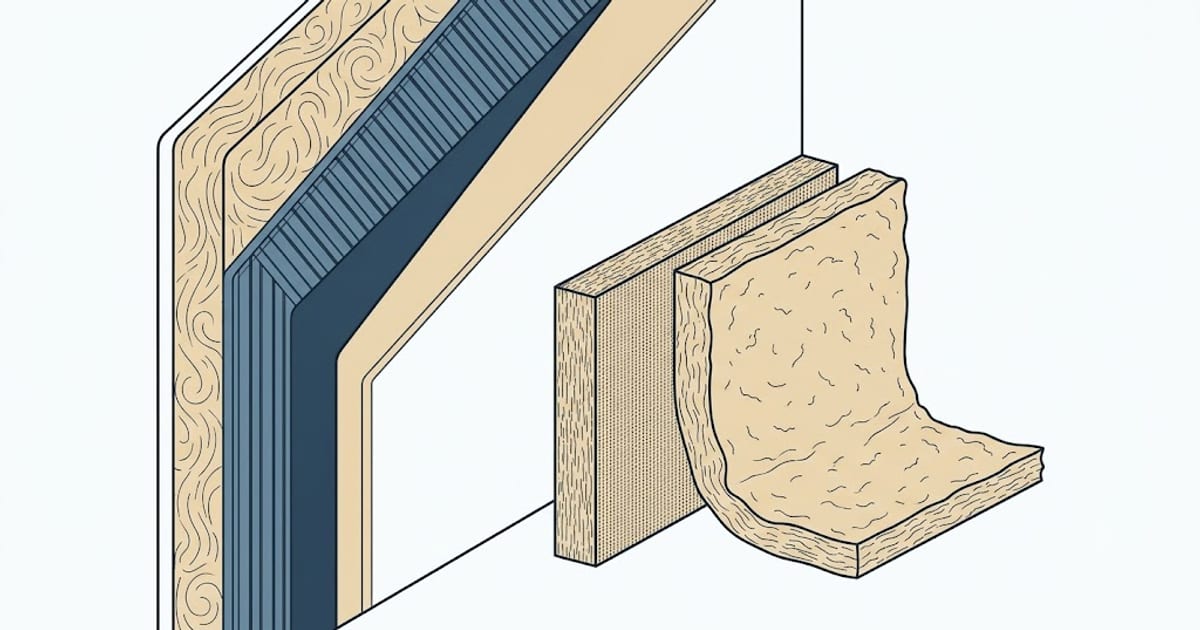
Mineral wool — sold as rock wool or stone wool — costs noticeably more than fiberglass and delivers about half a point per inch more R-value. If R were the only consideration, it would not sell.
Four other properties are what people are actually buying.
1. Density and how it fits
Mineral wool is roughly three to four times denser than standard fiberglass. In practice that means it behaves like a semi-rigid board rather than a blanket.
It holds its own shape, stands up in a bay by friction with no flanges or staples, and can be cut cleanly with a serrated blade to fit an odd opening. Fiberglass sags, needs support in a ceiling, and tends to bulge or fold if the bay is not square.
For non-standard bays, retrofit work and anything overhead, that stiffness is the main practical advantage. It is also easier to achieve a Grade I fit with, because a stiff batt does not fold itself into the corner of an awkward bay.
2. Fire
Mineral wool is made from molten rock and typically withstands well over 1,000 °C without melting. It is non-combustible in its own right.
Fiberglass is glass, so it does not burn either — but the binder does, and standard batts commonly carry a kraft paper facing that is a combustible surface. Unfaced fiberglass is non-combustible; faced fiberglass is not, and the facing has to be covered by a finish.
Where this matters in a house: around a flue or chimney chase, in a garage separating wall, in a party wall, and anywhere the assembly is doing a fire-rating job. In those places mineral wool is often specified rather than chosen.
3. Sound
Density is what stops sound, and this is where the gap is widest.
A mineral wool batt in an interior partition gives a materially better result than fiberglass of the same thickness — typically a few points of STC on an otherwise identical wall, and more of an audible difference than that number suggests at speech frequencies.
For bedrooms, home offices, media rooms and any wall onto a stairwell or a bathroom, this is usually the reason to pay the difference. It is a better use of the money than the extra half point of R.
4. Water
Mineral wool does not absorb water into its fibres. It drains and dries, and it recovers its performance when it does.
Fiberglass also does not absorb water chemically, but it holds it between the fibres, mats down, and loses loft — and a matted batt does not always recover its thickness.
In a basement wall, a rim joist, a crawlspace or any assembly where wetting is plausible, that difference is worth having. It is not a licence to insulate a wet wall; it is insurance against an event.
The comparison, side by side
| Fiberglass | Mineral wool | |
|---|---|---|
| R per inch | ~3.1–3.7 | ~3.7–4.3 |
| Density | Low, soft | 3–4× higher, semi-rigid |
| Holds its own shape | No | Yes |
| Non-combustible | Unfaced yes, faced no | Yes |
| Sound performance | Adequate | Noticeably better |
| Recovers after wetting | Poorly | Well |
| Cost | Baseline | Roughly 1.5–2× |
| Cutting | Blade or knife, dusty | Serrated blade, cuts clean |
| Handling | Itchy, fine fibres | Coarser, less airborne fibre |
Where to spend it
Use mineral wool in interior partitions where sound matters, around anything fire-related, in rim joists and basement walls, and in any bay awkward enough that a soft batt would not sit properly.
Use fiberglass for large runs of standard exterior wall where the cavity is square, the framing is regular and the job is straightforward thermal fill. It is cheaper per R and the difference in a well-installed standard bay is small.
The choice that matters more than either is installation quality — a well-fitted fiberglass wall beats a badly fitted mineral wool one, and by a wider margin than the materials differ. The grades are set out in installation grade beats nominal R, and bag count for either material comes off the wall batt page.