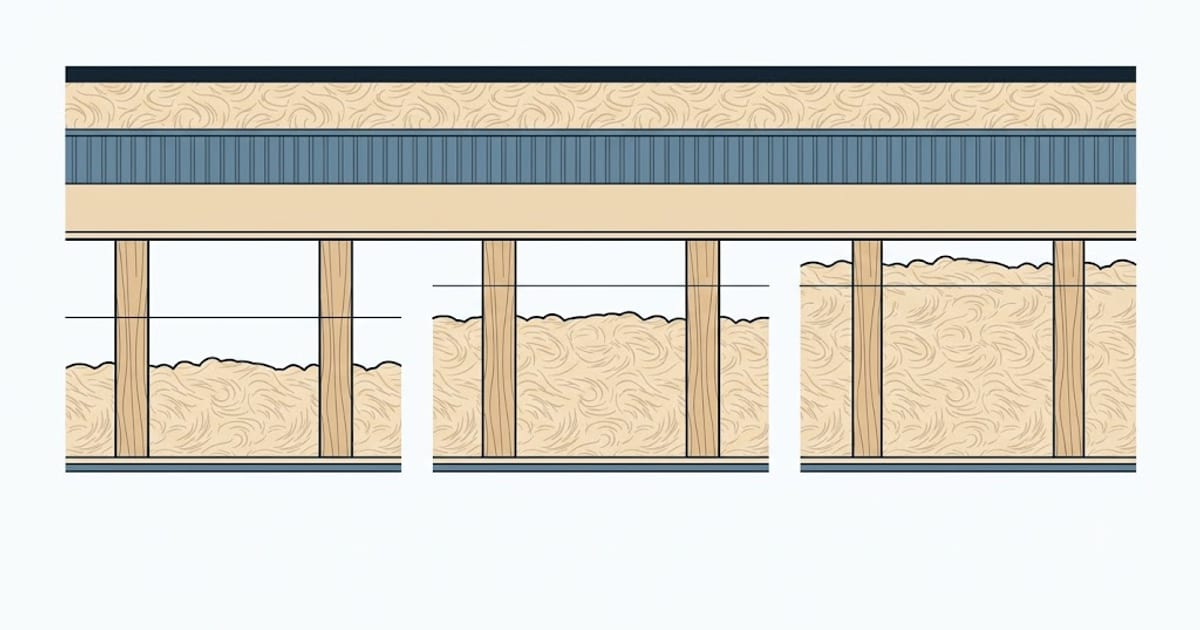
R-38, R-49 and R-60 are the three numbers that appear in attic recommendations, and the gap between them looks like a simple choice of "more is better." It is, but the amount better falls off sharply, and the arithmetic is worth seeing before you decide how deep to go.
The targets by zone are in the attic R-value page, and the whole-envelope table is here.
What R-value does to heat flow
Heat flow through an assembly is proportional to 1 ÷ R. That reciprocal is the whole story, and it is why each step matters less than the last.
Taking an uninsulated ceiling as the baseline:
| R-value | Relative heat flow | Removed vs bare | Removed vs previous step |
|---|---|---|---|
| R-0 (bare) | 100 % | — | — |
| R-13 | 7.7 % | 92.3 % | — |
| R-30 | 3.3 % | 96.7 % | 4.4 points |
| R-38 | 2.6 % | 97.4 % | 0.7 points |
| R-49 | 2.0 % | 98.0 % | 0.6 points |
| R-60 | 1.7 % | 98.3 % | 0.3 points |
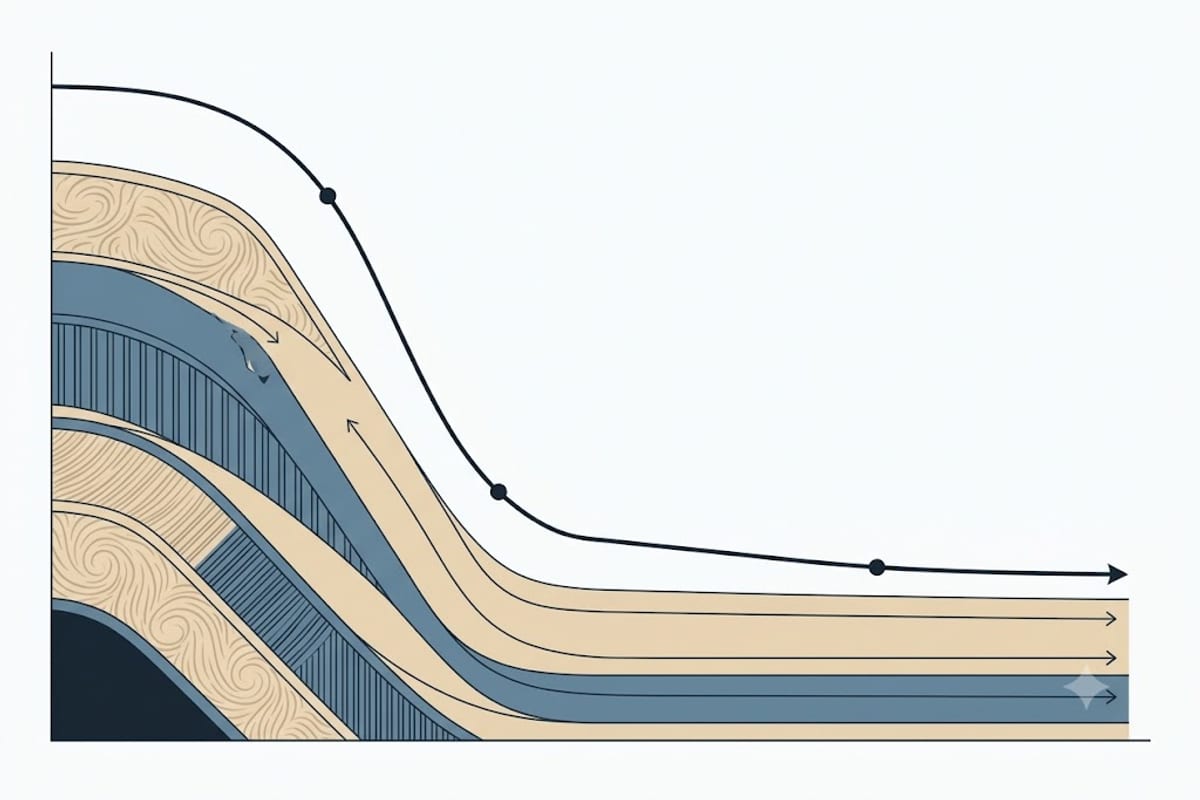
Read the last column. Going from bare to R-13 removes 92 % of the heat flow. Going from R-49 to R-60 removes another 0.3 % of the original.
That is not an argument against R-60. It is an argument for knowing what you are buying, because the framing "R-60 is 22 % more insulation than R-49" is true and completely misleading — the heat you save is a fraction of a fraction.
Then why does the code keep raising it?
Three reasons the diminishing-returns table does not capture:
Attic depth is cheap. The marginal cost of another six inches of blown fill in an accessible attic is small. Where the extra R is cheap, taking it makes sense even at a low marginal return. This is exactly why the code asks R-60 in ceilings and R-30 in walls.
It compounds with everything else. That 0.3 % is 0.3 % of the original bare-ceiling loss, but as a share of the remaining loss it is a 15 % reduction. If the rest of your envelope is good, the ceiling is a larger share of what is left.
Comfort is not energy. A deeper ceiling keeps the interior surface closer to room temperature, which reduces the cold-ceiling radiant effect and the temperature stratification that makes upstairs rooms uncomfortable. That is not visible on a bill.
What each step costs in depth
The R-value is the same; the inches are not.
| Material | R-38 | R-49 | R-60 |
|---|---|---|---|
| Blown fiberglass | 15.2″ | 19.6″ | 24.0″ |
| Fiberglass batt | 11.9″ | 15.3″ | 18.8″ |
| Blown cellulose | 10.9″ | 14.0″ | 17.1″ |
| Closed-cell spray foam | 5.8″ | 7.5″ | 9.2″ |
The jump from R-49 to R-60 in blown fiberglass is 4.4 extra inches across the whole attic floor. In a vented attic with headroom to spare that is free depth. In an attic where you are already close to the top of the joists at the eaves, or where you need a walkway, it is a real constraint.
Where the step is genuinely worth it
Take the higher number when:
- You are blowing loose fill into an accessible vented attic — the extra depth costs almost nothing.
- Your existing insulation is being topped up rather than replaced, so the marginal bags are the only cost.
- You are in zone 5 or above, where the heating season is long enough that small percentages accumulate.
The step matters less when:
- The attic has not been air sealed. Air leakage will dominate the loss and the extra R-value cannot fix it.
- Depth is constrained — near the eaves, under a low roof, or where a floor has to go over it.
- You are choosing between depth and fixing something else. Sealing the attic hatch, or baffling the soffits so the eaves are actually insulated, both beat the last eleven points of R-value.
The uniformity problem
An attic at an average of R-49 with bare patches performs worse than an attic uniformly at R-38, because heat flow through the gaps is disproportionate. A ceiling that is 95 % at R-49 and 5 % bare loses far more than the average suggests, since the bare 5 % is passing heat at fifty times the rate of the insulated part.
So before adding depth, check coverage: around the hatch, at the eaves where baffles should hold the path open, around chimneys and flues, over the top plates of interior walls, and anywhere someone has been up there and pushed the fill aside.
Uniform R-38 beats patchy R-60, and it is cheaper.
What this page does not cover
- Air sealing comes first, every time. Everything above assumes it is done.
- Depth per material and the settling problem are on the main attic page.
- Code minimums by zone are here — where the code sets a number, the arithmetic above is informational, not permission to go lower.
- The percentages assume steady-state conduction through the insulated area only. Real attics also lose heat through framing, leakage and ducts.
More is better. The useful question is how much better, and past R-49 the honest answer is "a little."