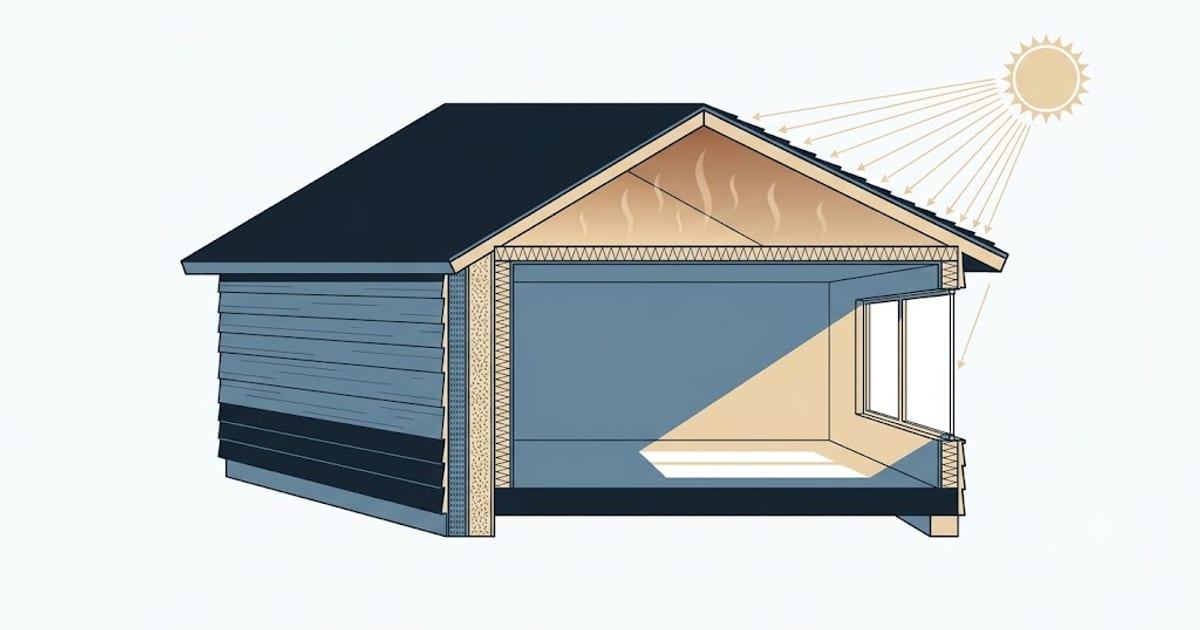
Insulation resists heat flow regardless of direction, so an insulated house is cooler in summer as well as warmer in winter. The useful question is where the summer heat comes from, because it is not where the winter heat goes.
The attic is not just hotter — it is much hotter
An unvented, uninsulated attic under a dark roof reaches 60 to 70 °C on a clear summer afternoon. The temperature difference across the ceiling can be 40 °C, against maybe 25 °C on a cold winter night in Zone 4.
That makes attic insulation the highest-value assembly in a cooling climate, and it is why Zones 1 to 3 specify serious attic R-values despite mild winters.
Walls, by contrast, see outdoor air at 35 °C against 24 °C inside — an 11 degree difference. Wall insulation does far less work in summer than in winter.
Solar gain through windows dominates
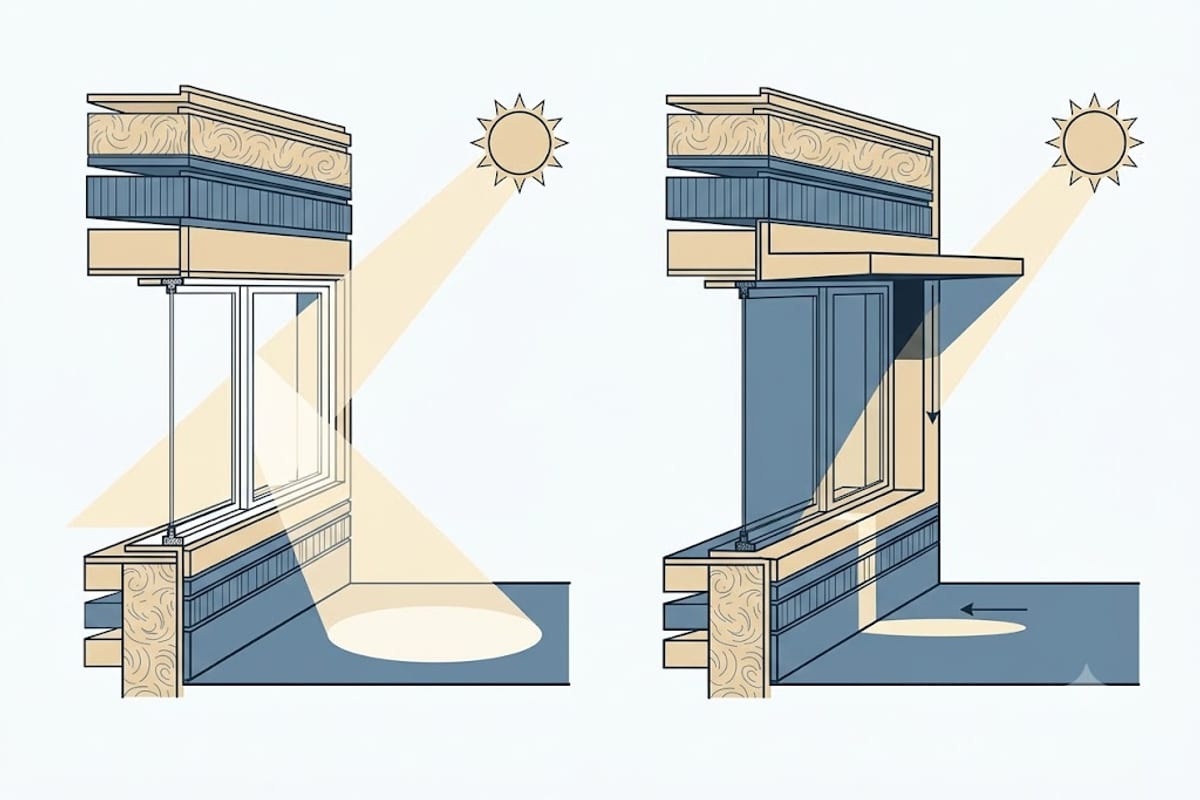
In most houses, direct sunlight through glass is the single largest summer heat gain, and it is not affected by insulation at all.
A square metre of unshaded west-facing glass admits several hundred watts on a summer afternoon. No practical amount of wall insulation offsets that.
Which is why, in a cooling climate, the priority order is different:
- Shade west and south glass — external shading, overhangs, planting
- Attic insulation and attic ventilation
- Air sealing
- Wall insulation
- Radiant barrier, if the attic is already well insulated
Radiant barriers, honestly
A radiant barrier is a reflective foil in the attic that reduces radiant heat transfer from the hot roof deck to the insulation below. In hot sunny climates it reduces cooling load by a few percent — a real but modest effect.
In cold climates it does almost nothing, because winter heat loss is conductive and convective rather than radiant, and because dust on a horizontal foil kills its emissivity within a couple of years.
Install it facing an air space, and never lay it flat on top of insulation where dust settles.
Thermal mass shifts the timing
Heavy construction absorbs heat during the day and releases it at night. In climates with a large day-night swing — the desert Southwest — that shift is genuinely useful, because the release happens when outdoor air is cool enough to vent.
In humid climates with warm nights it just moves the load a few hours later.
Air sealing works in both seasons
Hot humid air leaking in is worse in summer than cold dry air leaking in is in winter, because the air conditioner has to remove the moisture as well as the heat. Latent load is often a third of the cooling load in a humid climate, and almost all of it arrives through leaks.
Roof colour does more than a radiant barrier
The attic temperature that drives summer heat gain is set largely by how much solar energy the roof absorbs, and that is a property of the covering rather than of anything inside.
A dark asphalt roof absorbs most of what hits it and can reach 70 °C on a clear afternoon. A light-coloured or specially coated "cool roof" surface reflects a much larger share and typically runs 15 to 25 °C cooler, which pulls the whole attic down with it.
The measures to look for are solar reflectance — how much sunlight bounces straight back — and thermal emittance, how readily the surface re-radiates the heat it did absorb. A good cool roof is high in both. Manufacturers publish them, and the pair is often combined into a single Solar Reflectance Index.
Two limits worth stating. It only pays where cooling dominates: in a cold zone the winter penalty from a reflective roof roughly cancels the summer gain. And it is a re-roofing decision — repainting an existing asphalt roof is not a thing.
What attic ventilation does, and what it does not
Ventilation and insulation get treated as alternatives and they are not.
What it does: carries away moisture that reaches the attic, keeps the roof deck closer to outdoor temperature, and in cold climates prevents the melt-freeze cycle at the eaves that builds ice dams.
What it does not do: cool the house. A vented attic runs a few degrees cooler than an unvented one, and against a 40 °C ceiling temperature difference that is a small correction. Ventilation is a moisture and durability measure first.
The usual specification is 1 square foot of net free vent area per 300 square feet of attic floor, split roughly evenly between intake at the eaves and exhaust at the ridge — and the intake half is the one that is routinely missing, usually because insulation has been pushed over the soffit vents.
Do not mix exhaust types. A ridge vent and gable vents together, or a powered fan alongside a ridge vent, can short-circuit: the exhaust pulls air from the nearest opening rather than from the eaves, and the far end of the attic gets no flow at all. Pick one exhaust strategy.