Zone 5 runs across a wide band of the country — much of the Midwest, the interior Northeast, and higher elevations further south. It also sits exactly on the step where the code moved, which makes "what R-value does zone 5 need" a question with two defensible answers.
The full zone table is here, and the material depths are on the main attic page.
The two answers
| Code edition | Zone 5 ceiling |
|---|---|
| IECC 2015 / 2018 | R-49 |
| IECC 2021 | R-60 |
Both are real requirements that are currently enforced somewhere. Which one governs your job depends on what your jurisdiction has adopted, and adoption lags publication by years. Ask the building department. If the answer is R-49 and you are blowing loose fill anyway, going to R-60 costs a few extra bags and is worth taking.
How deep that is
| Material | R-49 | R-60 |
|---|---|---|
| Blown fiberglass | 19.6″ | 24.0″ |
| Fiberglass batt | 15.3″ | 18.8″ |
| Blown cellulose | 14.0″ | 17.1″ |
| Mineral wool batt | 15.8″ | 19.4″ |
| Closed-cell spray foam | 7.5″ | 9.2″ |
For a vented attic floor where nobody lives, the cheap fibrous materials win easily and the depth is free. Foam's advantage is inches, and inches only matter where they are constrained.
The top-up calculation
Most zone 5 attics are not empty. They have something up there from whenever the house was built, and the question is what to add.
R-values add. Existing R plus added R equals total R, provided the existing material is dry, in place, and not compressed.
The problem is knowing what the existing R actually is. Depth alone does not tell you, because old insulation has settled and its R-per-inch has changed. Working estimates:
| What is up there | Realistic R per inch |
|---|---|
| Old settled fiberglass batt | ~2.9 |
| Old blown fiberglass, settled | ~2.2 |
| Old blown cellulose, settled | ~3.2 |
| Vermiculite | ~2.1 |
Measure the depth in several places — not one — and take the lowest reading, because the low spots dominate the heat loss.
Worked example. A zone 5 attic under a 2021-vintage code, with 7 inches of old settled blown fiberglass:
- Target: R-60
- Existing: 7″ × 2.2 = R-15
- Shortfall: 60 − 15 = R-45 to add
- In cellulose: 45 ÷ 3.5 = 12.9 inches on top
- Settling allowance: blow to the manufacturer's installed depth that settles to R-45, which is typically an inch or more deeper on the day.
Note how little R-15 the old seven inches is worth. That is normal, and it is why "there's already insulation up there" is a weak reason not to add more.
Vermiculite: stop and check
If the existing material is loose granular pellets rather than fibre — small, light, greyish-brown, roughly the size of coarse gravel — it may be vermiculite. Some vermiculite sold in the twentieth century is contaminated with asbestos.
Do not disturb it, do not blow over it, and do not work in that attic until it has been identified. This is a job for testing and, if positive, professional handling. It is the one situation on this page where the correct next step is to stop rather than to calculate.
What zone 5 specifically punishes
Zone 5 has both a long heating season and a real cooling season, and two failure modes show up because of it.
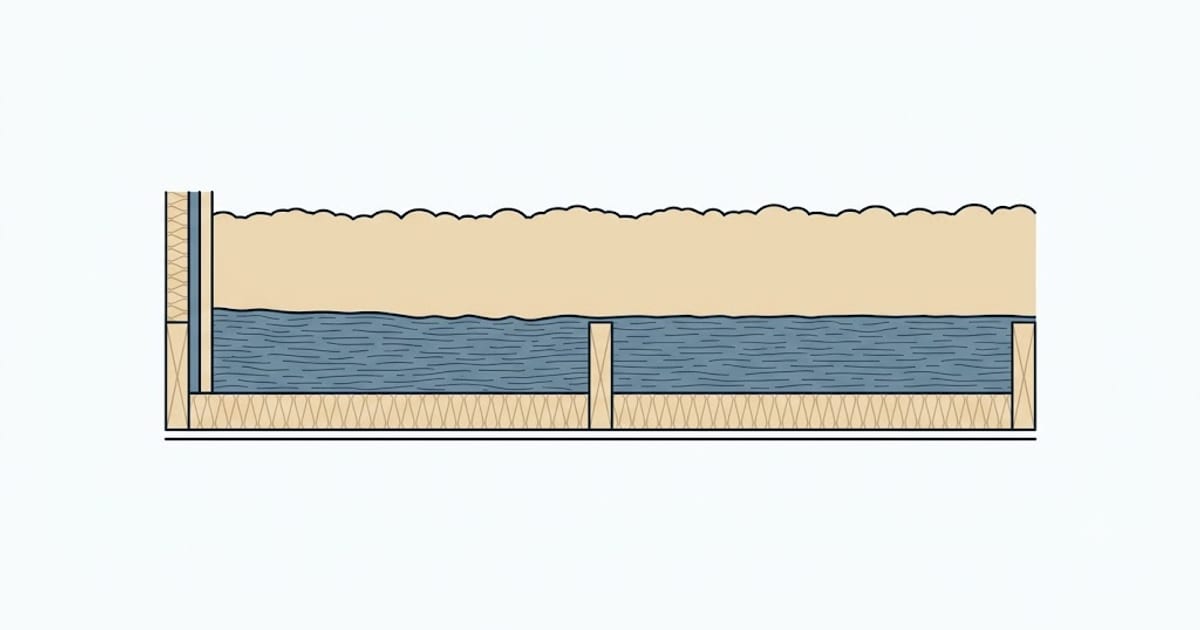
Ice dams. Heat escaping into the attic melts snow on the roof, the meltwater runs down to the cold eave and refreezes, and the resulting dam backs water up under the shingles. The cause is heat and air leaking into the attic, not insufficient R-value in the middle of the ceiling. The fix is air sealing plus insulation carried properly out over the top plate at the eaves — which is exactly where insulation is usually thinnest, because that is where the roof meets the wall and there is no headroom.
Summer attic temperature. A vented zone 5 attic gets genuinely hot in July. Anything stored up there, and especially any ductwork, is in that environment. Ducts in an unconditioned attic lose a large fraction of their conditioning, and no amount of ceiling insulation fixes a leaky duct above it.
Before the depth
The order does not change by zone:
- Air seal every penetration — top plates, wiring, plumbing, chases, the hatch.
- Baffle the eaves so soffit intake stays open when the fill goes in.
- Deal with heat sources — non-IC-rated recessed lights, flues, chimneys need permanent clearance.
- Then blow.
What this page does not cover
- Vapour retarders in zone 5 — the assembly matters and getting the retarder on the wrong face causes condensation.
- Cathedral and unvented attics are a different problem where moisture control drives the design.
- Ducts and air handlers in the attic are frequently a larger loss than the ceiling itself.
- Local amendments to the model code always win over the two-answer table above.
R-49 or R-60 depending on your inspector. About 14 to 17 inches of cellulose either way, and the air sealing matters more than which number you pick.