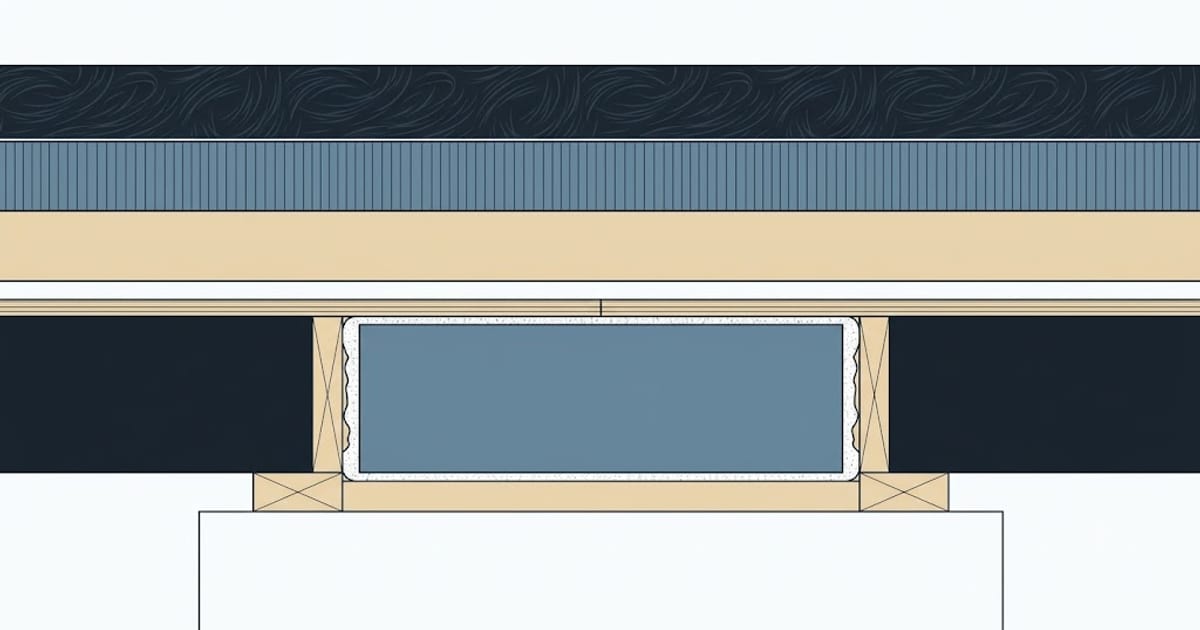
The rim joist — the band board closing the ends of the floor joists — sits directly on the foundation, is exposed to outdoor air across its full thickness, and is riddled with the gaps where joists, subfloor and sill plate meet.
It is a small area doing an outsized amount of damage.
Why batts fail here
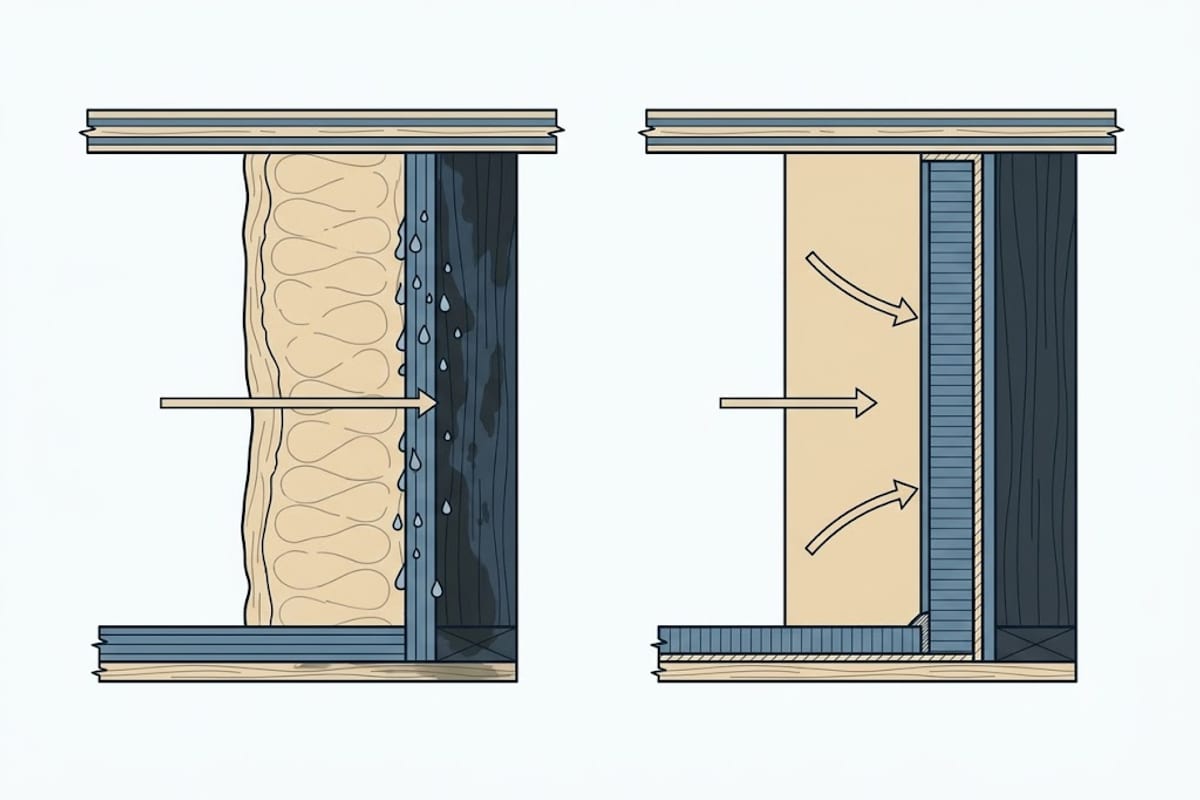
A fiberglass batt stuffed into a rim joist bay does not stop air. Warm humid indoor air passes straight through it, reaches the cold band board behind, and condenses there.
The insulation then holds that moisture against the wood. Rim joists insulated with batts are one of the most reliable places to find rot and mould in an otherwise dry basement, and the batt hides it.
Fiberglass is a filter, not an air barrier. In an assembly where the cold surface is right behind it and the air can get there, that distinction decides whether the wood survives.
What works: rigid foam, sealed
Cut rigid foam to fit each bay — 2 inches of XPS or polyiso gets most climates to code — press it against the band board, and seal the perimeter with canned foam.
The foam board is the insulation. The sealed perimeter is the air barrier, and it is the part that matters. Air cannot reach the cold surface, so nothing condenses there.
Two inches of polyiso is about R-13; 3 inches gets to R-19 for colder zones. IECC treats the rim joist as part of the wall, so the wall R-value for your zone is the target.
What also works: closed-cell spray foam
Two inches of closed-cell foam does insulation, air barrier and vapour retarder in one pass, and it conforms to the irregular geometry that makes rim joists tedious to cut for.
It is the faster answer where there are many bays, and the more expensive one for a handful.
What not to do
Do not put a polyethylene vapour barrier over batts here. That traps any moisture that does get in, against the wood, permanently.
Do not skip the perimeter seal on foam board. Foam board cut slightly small and left unsealed performs like a batt, because the air simply goes around it.
Do not insulate over existing rot. Probe the band board with a screwdriver before covering it. Soft wood at the sill is a structural repair, not an insulation project.
Where it sits in the priority order
For a house with an uninsulated rim joist and a code-compliant attic, the rim joist is the better investment — a small material cost against an assembly that is currently at roughly R-3.
It also tends to be the largest single air leak in a basement, which means the return is bigger than the R-value change alone suggests.
The sequence for one bay
The order matters, because two of these steps become impossible once the next one is done.
1. Probe the band board. A screwdriver into the wood at the sill line. Soft or punky wood is a repair, not an insulation job, and covering it hides it.
2. Seal the sill-to-foundation joint first. The gap between the timber sill plate and the concrete below it is a continuous crack around the whole building. It is the single largest air leak in most basements, and once the foam board is in you cannot reach it. Canned foam or sealant along that line, before anything else goes in.
3. Cut the board slightly undersize. Aim for about half an inch of gap all round. A board cut tight has to be forced, which bows it away from the band and leaves an air space behind — the one thing the whole exercise is trying to prevent.
4. Press it flat against the band board, not floating in the middle of the bay.
5. Foam the perimeter. Every edge, continuously. This is the air barrier and it is the step that decides whether the assembly works.
6. Trim the squeeze-out once cured, and check by eye that there is no gap left anywhere around the edge.
At two or three minutes a bay after the first one, a typical basement is an afternoon.
The joist bay at the end wall is different
Where floor joists run parallel to the exterior wall, there is no bay — just a continuous cavity between the last joist and the rim. It is usually deeper, often has the sill bolt heads in it, and it is where people run out of patience.
It is also the bay most likely to be missed entirely, because it does not look like the others. Treat it the same way: cut foam to fit the full run, seal the perimeter, and do not leave the end sections at the corners open.
What a good result looks like
On a cold day, the band board behind the foam should be cold and the room side of the foam should be at room temperature — that is the assembly doing its job. What you must not have is warm moist room air able to reach that cold board.
If a basement smells musty after the work, the seal is incomplete somewhere. It is worth finding rather than living with, because the moisture is condensing on structural timber.