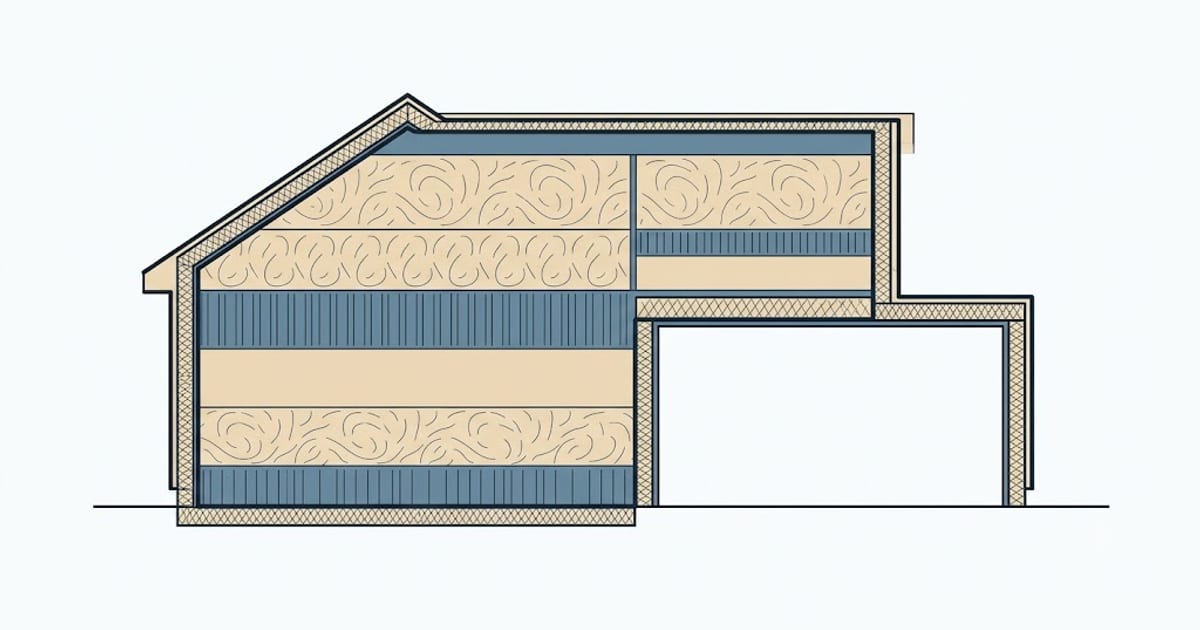
A garage can be three different things, and the correct insulation strategy is different for each.
1. Unheated, attached — a buffer
Here the thermal boundary is the house-to-garage wall, not the garage exterior. Insulating the garage's outside walls buys very little; insulating and air-sealing the shared wall and the ceiling below living space buys a lot.
Priorities:
- Shared wall to full code wall value for your zone (R-20 or R-13+5 in most of the US), air sealed.
- Ceiling under living space to floor values — R-30 in Zone 4 and above — and it must be an air barrier. Vehicle exhaust and stored chemicals are on the other side.
- Garage door to the house: fire-rated, self-closing, weatherstripped. This is a code requirement, and it is also the largest air path.
Insulating the garage door and exterior walls in this case makes the garage a few degrees milder and does almost nothing for the house.
2. Heated workshop — inside the envelope
Now the garage exterior is the thermal boundary and everything gets treated as house.
- Walls to zone code, air sealed.
- Ceiling or roof to attic values.
- Slab edge insulation — often skipped, and a heated slab loses a great deal at its perimeter. R-10 rigid at the slab edge, 2 to 4 ft down or inward.
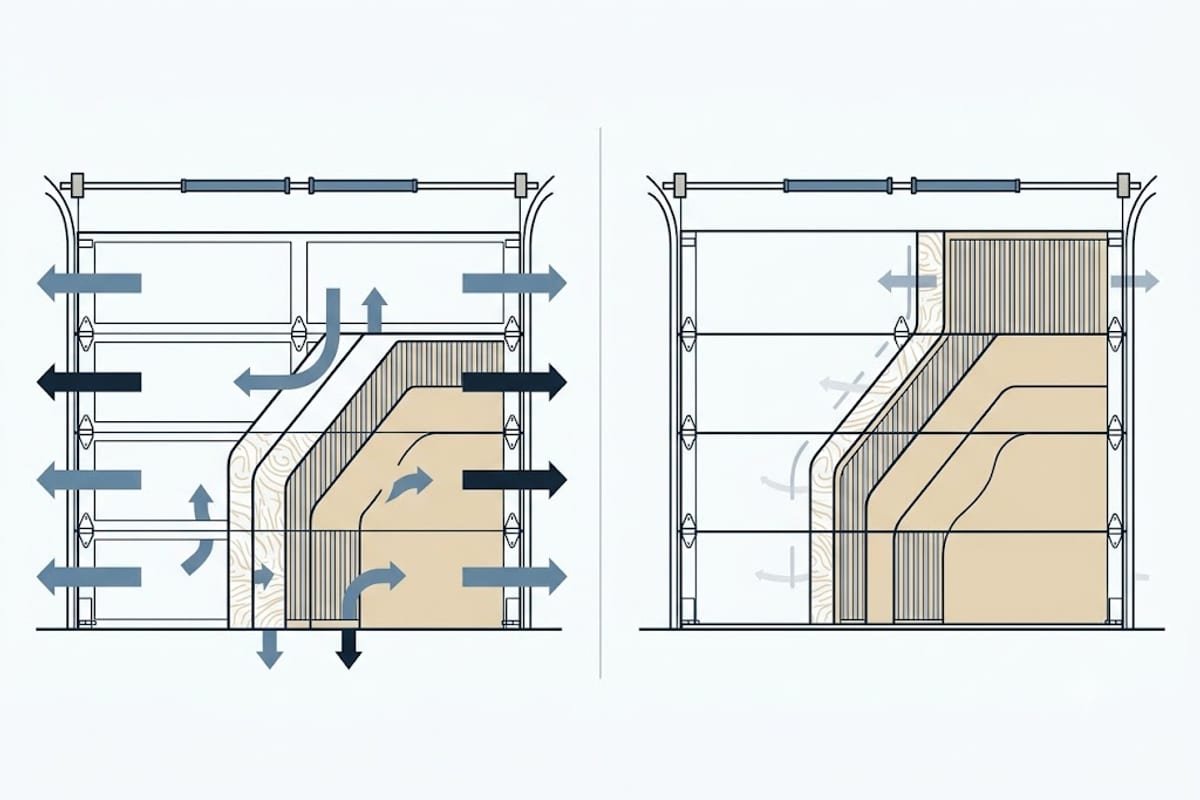
- Garage door insulated, and this now matters: a bare steel door is about R-2 over a large area. An insulated sectional door reaches R-9 to R-18.
The door is usually the weakest assembly by a wide margin, and in a heated garage it is worth spending on.
3. Detached — heat it or do not
An unheated detached garage gains almost nothing from insulation, because there is no temperature difference to resist for most of the year.
If it is heated intermittently — a workshop used at weekends — insulation plus a fast-response heater is the right combination. Mass and insulation together suit continuous heating; insulation and quick heat suit intermittent use.
The thing that catches everyone
Insulating a garage without heating it does not make it warm. It makes it slower to change temperature. A well-insulated unheated garage in January is cold, and it stays cold longer once the sun goes off it.
If the goal is a usable space in winter, the insulation is a prerequisite for heating, not a substitute for it.
Ventilation, since it is a garage
An attached garage must not share air with the house. Seal every penetration in the shared wall and ceiling — wiring, plumbing, the attic hatch if there is one, and the top plate. Carbon monoxide moves through gaps that heat barely notices.
Insulating the garage door, and the spring problem
The door is usually the weakest assembly in a heated garage — a bare steel sectional is around R-2 over a very large area — and it is also the one place a straightforward upgrade has a mechanical consequence.
Retrofit kits are rigid panels cut to fit each section, held by clips. They typically reach R-4 to R-8 and cost a fraction of a new door.
Factory-insulated sectional doors are polyurethane injected between steel skins and reach R-9 to R-18, with better panel stiffness and a much better perimeter seal.
The catch with a retrofit kit: it adds weight, and a sectional door is counterbalanced by springs sized for the original weight. A door made noticeably heavier will not stay put where you leave it, will strain the opener, and in the worst case will come down faster than it should.
After adding a kit, the door should hold its position when raised halfway with the opener disconnected. If it drifts down, the springs need rebalancing — a job for someone with the right tools, because torsion springs under load are the one part of a garage that genuinely injures people.
The perimeter seal matters as much as the panel. Bottom weatherstrip, side and top seals. A well-insulated door with a half-inch gap along the bottom is an open window in a wall.
Insulating without heating makes a damp garage
A common sequence: insulate an unheated garage, then find condensation on the car, on tools, and on the underside of the roof deck.
The reason is that insulation slows the garage's response to outdoor temperature. A wet car driven in at night now sits in a space that stays cool and does not dry, instead of one that warms with the morning sun and vents.
Two things prevent it. Ventilation — a passive vent high and low, or a small extract fan on a humidistat, so moisture from cars and washing has somewhere to go. And occasional heat, enough to keep surfaces above dew point rather than to make the space comfortable.
If tools are rusting in an insulated garage, the answer is airflow, not more insulation.