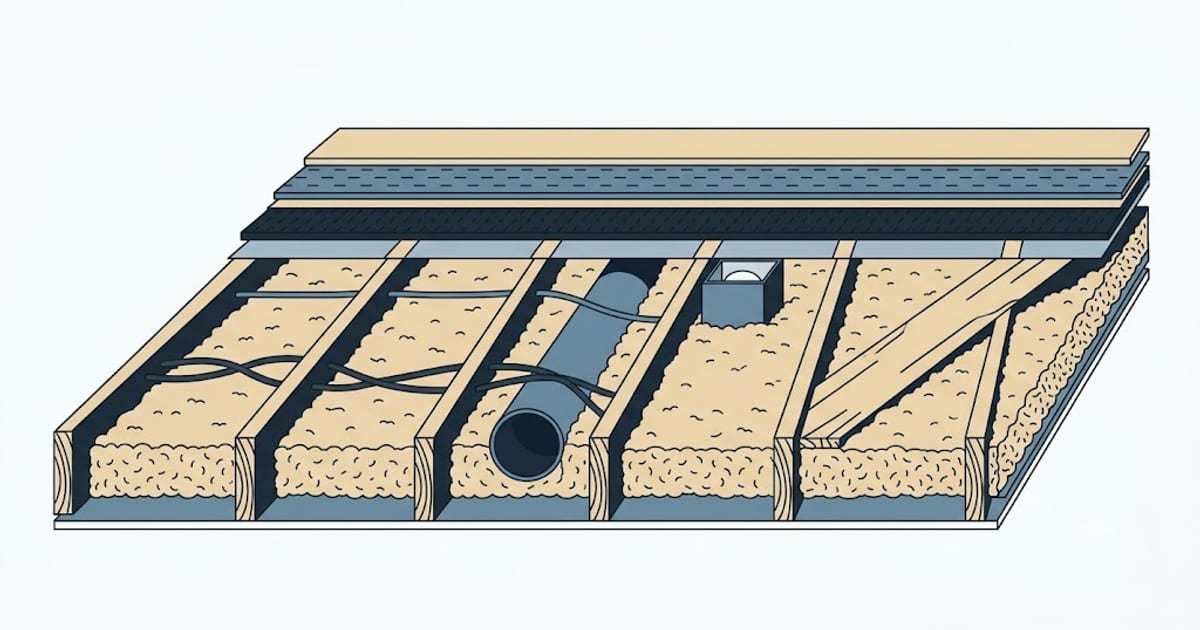
Batts and blown insulation reach similar R-values per inch. Where they differ is how well each one fills an awkward space, and awkward spaces are where insulation actually lives.
| Material | R per inch | Notes |
|---|---|---|
| Fiberglass batt | 3.1–3.4 | R-13 in 2×4, R-19–21 in 2×6 |
| High-density fiberglass batt | 3.7–4.3 | R-15 in a 2×4 |
| Blown fiberglass | 2.2–2.7 | Loose, low density |
| Blown cellulose | 3.2–3.8 | Denser, better air resistance |
| Mineral wool batt | 3.7–4.3 | Fire and sound performance |
Attics: blown wins on installation quality
An attic floor is full of obstructions — joists at irregular spacing, wiring, bracing, ducts, the ceiling boxes. Batts have to be cut around every one, and every cut is a chance to leave a gap.
Blown insulation flows around them. A study-grade batt install in a clean attic beats blown material; a real attic almost never permits one.
Blown also lets you add depth cheaply, which is exactly what an attic wants.
Walls: batts win, unless the wall is closed
An open stud bay is a rectangle. Batts fit rectangles, and they are far cheaper and cleaner to install than setting up a blowing rig.
In a closed wall — retrofit, existing plaster — dense-pack cellulose blown through drilled holes is the only practical option, and it is a good one. Dense-packed at 3.5 lb/ft³ it resists settling and substantially reduces air movement inside the cavity.
Settling is the objection, and it is mostly historical
Loose-fill cellulose settles about 20% from its blown depth; manufacturers account for this and the coverage chart states settled depth. Follow the bag's coverage table, not the depth you happen to see on install day.
Dense-pack does not settle meaningfully. Blown fiberglass settles very little.
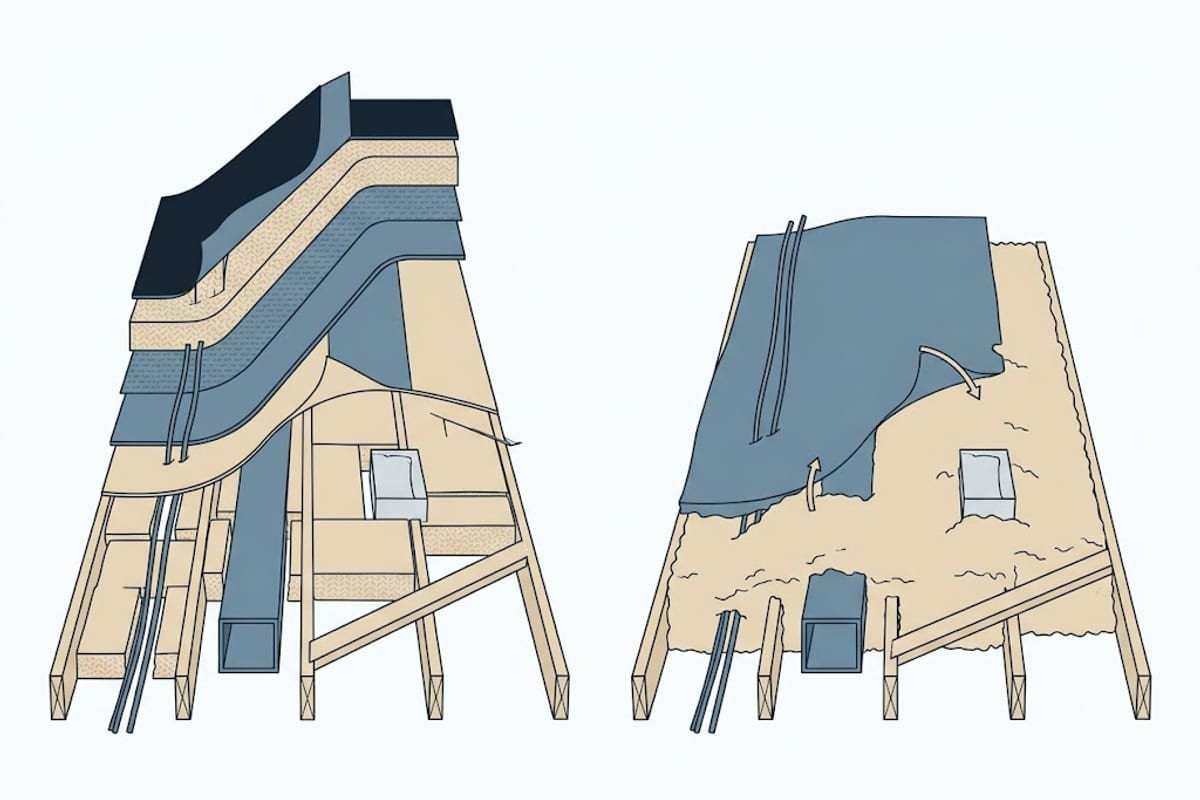
Coverage charts are the specification
Every bag states: how many square feet it covers at a given R-value, the minimum bag count per 1,000 ft², and the settled depth. Bag count is what makes the R-value, not depth on the day.
Installers short on bags produce fluffed material at the right depth and the wrong density, which measures fine with a ruler and underperforms for the life of the house. Count the empty bags.
Mineral wool, briefly
Higher R per inch than fiberglass, does not burn, does not absorb water, and much better at sound. It costs more and it is stiffer to work. Where it earns its place: party walls, mechanical rooms, and rim joists.
Whichever you choose
The insulation is second. Air sealing is first, and the return on sealing a leaky ceiling is several times the return on the last R-10 above it.
Work out quantities either way on the attic calculator — it takes bag counts from the coverage chart rather than from depth.
Dense-pack, and how to tell it was done
"Dense-pack" is not a marketing word — it is a density, and it is what separates a closed-wall retrofit that works from one that settles into a gap at the top of every bay within two years.
The target is around 3.5 lb per cubic foot for cellulose. At that density the material is firm to the touch through the hole, it does not settle, and it substantially slows air movement inside the cavity — which is a large part of the benefit in a wall that has no other air barrier.
Loose-fill in the same cavity is around 1.5 lb/ft³, looks identical when it goes in, and behaves completely differently.
Two ways to verify, both worth insisting on:
Count the bags against the wall volume. Cavity volume in cubic feet × 3.5 = pounds of material. A 2×4 wall bay is roughly 0.29 ft³ per foot of height. If the bag count is well under the calculation, the density is not there whatever the depth looks like.
Feel it through a hole before patching. Correctly dense-packed material resists a finger firmly. Loose material gives.
What blowing into a closed wall actually involves
Worth knowing before agreeing to it, because the process leaves marks.
A hole per bay, typically 2 inches, drilled through the cladding or the interior finish. On a two-storey wall that is one hole per bay per floor, plus extra holes above and below any fire blocking, which the crew finds by probing.
A fill tube, not a nozzle, for dense-pack. The tube is pushed to the far end of the cavity and withdrawn as the material builds, which is what achieves the density. A nozzle held at the hole packs the near end and leaves the far end loose.
Patching. Plugs in siding, or plaster and paint inside. From outside on vinyl or timber cladding the holes are essentially invisible afterwards; on brick or render they are not, which is why the interior route is sometimes chosen instead.
Obstructions are found the hard way. Old bracing, plumbing, previous partial insulation and fire blocking all interrupt a cavity, and each needs its own hole. A crew that drills one hole per bay and no more has not filled the wall.
The one thing that cannot be recovered afterwards is density, because nobody can see it once the wall is closed. That is why the bag count is the specification.