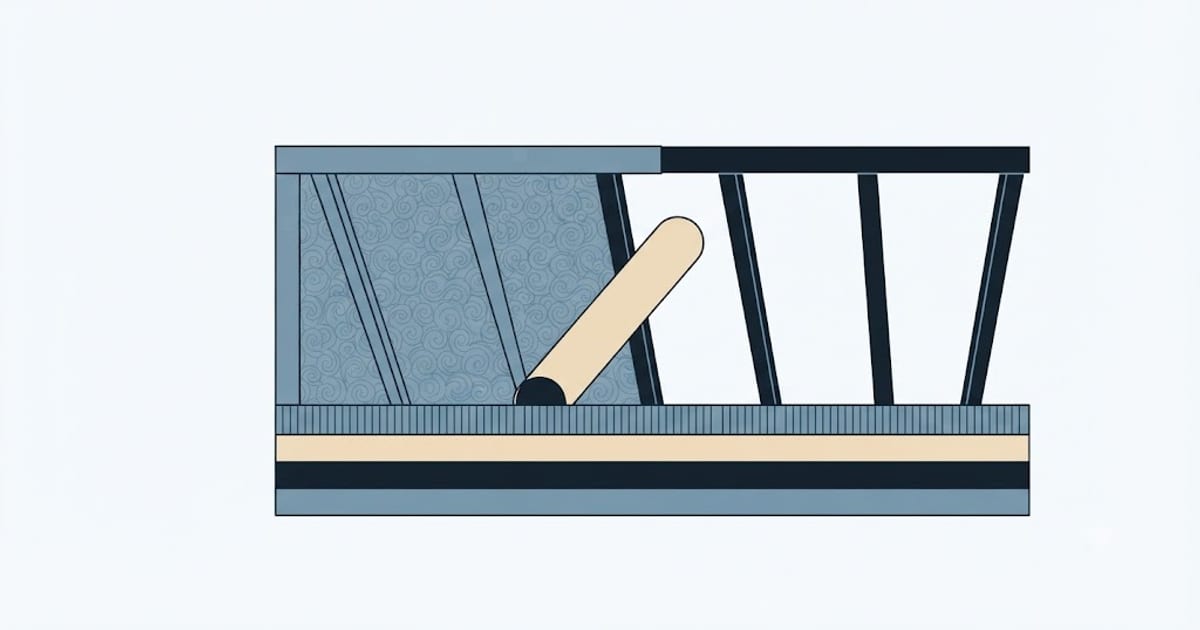
Removal is the expensive half of an attic insulation job, and it is the half that is most often sold when it is not needed. Old insulation is not worn out. Fiberglass and cellulose do not expire; they lose performance by settling and by getting wet, and settling is fixed by adding more on top.
So the question is never "how old is it". It is whether one of four specific things is true.
What it costs
| Work | Typical per sq ft |
|---|---|
| Removal, clean loose fill, vacuum truck | $1.00 – 2.20 |
| Removal, contaminated (rodent, mould) with sanitising | $2.00 – 4.00 |
| Removal of batts by hand, bagged out | $0.80 – 1.80 |
| Disposal | usually included; $150 – 500 if itemised |
| Replacement to R-49, loose fill | $1.75 – 3.50 |
Typical US contractor pricing at the time of writing, not quotes.
On a 1,200 sq ft attic: removal and replacement lands around $3,300 – 6,800, against $2,100 – 4,200 for topping up alone. Removal is not a small line item — it is roughly the cost of the insulation again. See blown-in attic insulation cost for what the replacement half contains.
The four cases that justify it
1. Rodent or bird contamination. Droppings and urine soak into loose fill and do not come out. This is the most common legitimate reason and it is not negotiable — the material is a health issue, and the smell will not clear. Sanitising after removal is part of the job, and so is finding and sealing the entry point. Removing without sealing means paying twice.
2. Water damage or mould. Insulation that has been repeatedly wetted by a roof leak is compressed, likely mouldy and no longer delivering its rating. Fix the leak first; insulation replaced under an active leak is money set on fire.
3. Smoke or fire damage. Loose fill holds smoke odour indefinitely.
4. Vermiculite that tests positive for asbestos. Vermiculite loose fill — small, pebble-like, gold or grey-brown — installed before the 1990s may contain asbestos from the Libby, Montana source. Do not disturb it and do not vacuum it. Have it sampled by an accredited lab, and if positive, abatement is a licensed trade with its own pricing, well above the figures above. Undisturbed vermiculite in a sealed attic floor is generally left in place.
What does not justify it
"It's old." Age alone changes nothing. Settled fiberglass from 1985 still delivers close to its per-inch rating at the depth it now sits at.
"It's dirty-looking." Grey streaking along the edges of loose fill is dust filtered out of air moving through gaps in the ceiling below. It is a sign you have air leaks — a real finding, and one that calls for the attic air sealing checklist, not for removal.
"You can't mix materials." You can. Blowing fiberglass over cellulose, or over old batts, is normal and code-compliant — see blown-in vs batt insulation for how the two behave together. The only requirement is that nothing traps moisture — which means no second vapour barrier over the top.
"We need to remove it to air-seal." Sometimes true, often not. Sealing the big leaks — top plates, chimney chase, dropped soffits, the hatch — can usually be done by pushing existing fill aside and putting it back.
Getting a straight answer
Two questions separate a real recommendation from an upsell:
- "Which of these applies, and can you show me?" Contamination and water damage are visible. Ask for photographs from inside the attic. A contractor who has been up there will have them.
- "What does the job cost without removal?" If both numbers are on the table, the removal line is priced honestly. If removal is bundled so it cannot be separated, that is the answer to the question.
If you are removing anyway
Do these while the attic floor is bare, because it will never be this accessible again:
- Air-seal everything. This is the whole reason a bare deck is worth something.
- Fit baffles at the eaves so the new fill does not bury the soffit vents. Burying intake is the fastest way to turn a well-insulated attic into a damp one.
- Deal with recessed lights. Anything not IC-rated needs a box over it or replacing.
- Check the bathroom fan ducts actually terminate outside rather than into the attic.
- Dam the hatch so fill does not spill every time it opens.
The short version
Removal roughly doubles the job, to $3,300 – 6,800 on a typical 1,200 sq ft attic. Do it for contamination, water, smoke or asbestos-bearing vermiculite. For anything else, add over the top and spend the difference on air sealing, which is where the savings actually come from.