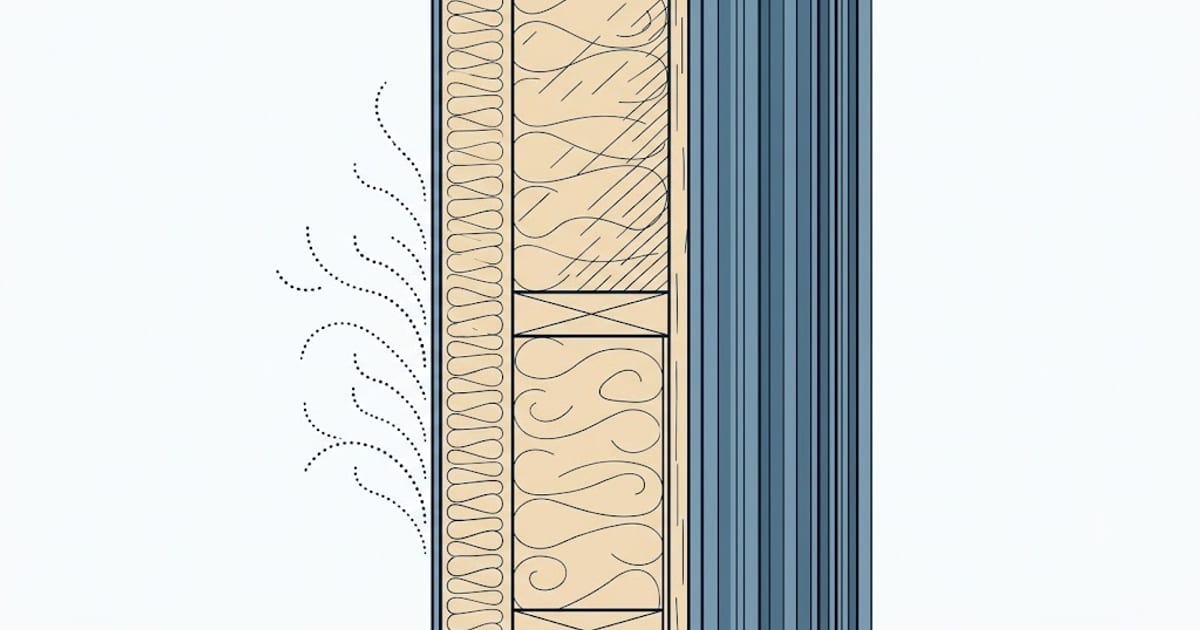
The rule: a vapour retarder goes on the warm-in-winter side of the insulation.
In a heating climate that is the interior. Warm indoor air holds much more moisture than cold outdoor air, so vapour drives outward, and the retarder stops it before it reaches a surface cold enough to condense.
Why the rule reverses
In a cooling-dominated climate the drive is inward — hot humid outdoor air toward a cool dry interior. An interior polyethylene sheet is then on the cold side, and moisture condenses on its outer face, inside the wall.
That is why interior poly is standard practice in Canada and a genuine hazard in Florida.
Mixed climates have no fixed answer
Zones 4 and 5 heat in winter and cool in summer, so the vapour drive reverses seasonally. Any fixed impermeable layer is wrong for part of the year.
Two solutions:
Smart vapour retarders — membranes whose permeance changes with humidity. Closed in winter when indoor air is dry, open in summer to let the assembly dry inward. This is what MemBrain and similar products do, and it is the standard answer in mixed climates.
Design for drying, not for stopping. Use kraft-faced batts (about 1 perm, a retarder rather than a barrier) and make sure at least one side of the assembly can dry.
The distinction that matters
- Vapour barrier: 0.1 perm or less. Polyethylene, foil.
- Vapour retarder, Class II: 0.1–1.0 perm. Kraft facing.
- Vapour retarder, Class III: 1.0–10 perm. Latex paint.
Most assemblies want a retarder, not a barrier. Slowing vapour is enough; stopping it removes the assembly's ability to dry, and everything eventually gets wet somehow.
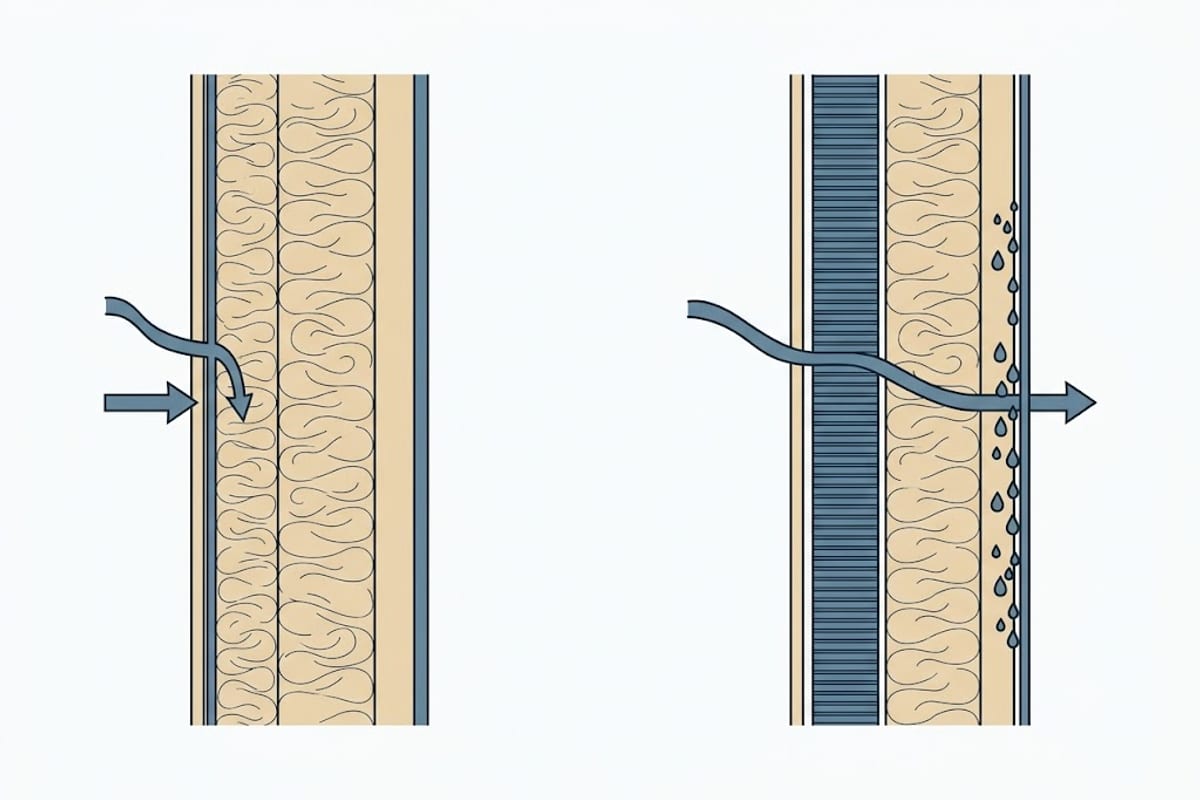
Air sealing does more than vapour control
Far more moisture moves through an assembly carried by air leaks than by vapour diffusion — commonly by a factor of ten or more. A perfect vapour barrier full of holes for wiring is worse than no barrier and a well-sealed air barrier.
If you have to choose where to spend care, spend it on the air barrier.
Where a real barrier does belong
Under a slab. 10–15 mil polyethylene directly beneath concrete, seams lapped and taped. There is no drying direction downward, and the ground is an infinite moisture source.
On a crawlspace floor. 6 mil minimum across the whole ground surface, lapped up the walls and sealed. This is the single most effective moisture measure in a crawlspace, ahead of any amount of ventilation.
Perm ratings of what is already in your wall
Every material has a permeance, and the assembly's behaviour is decided by which layer is tightest and where it sits.
| Material | Perms (approx.) | Class |
|---|---|---|
| Polyethylene, 6 mil | 0.06 | Barrier |
| Foil facing | 0.05 | Barrier |
| Closed-cell spray foam, 2 in | 0.8 | II |
| Kraft facing on a batt | 1 | II |
| XPS board, 1 in | 1.1 | II |
| Vapour-retarder primer | 0.5–1 | II |
| Latex paint, two coats | 3–5 | III |
| OSB sheathing | 2–5 | III |
| Plywood sheathing | 1–10 | III (varies with moisture) |
| Unfaced fiberglass | 30+ | None |
| Housewrap | 10–50 | None |
Two readings matter. Plywood changes with humidity — it opens up as it gets damp, which is a useful self-drying property that OSB has much less of. And ordinary latex paint is already a Class III retarder, which in many mixed climates is all the vapour control an assembly needs.
Working out what you already have
Before adding anything, find out what is in there — adding a second retarder on the wrong side is how walls get trapped between two barriers.
Pull a switch or socket cover on an exterior wall. You can usually see the insulation and whether it is faced, and which way the facing points.
Look in the attic at the top plate. The facing direction on the wall batts below is often visible from above.
Check the age. Interior polyethylene became common in cold-climate construction from the 1980s. Kraft-faced batts have been standard far longer.
Look for foam board outside, at an exposed edge such as under the eaves or where cladding meets a foundation.
The rule that follows: never sandwich insulation between two low-perm layers. If there is already poly inside, do not add closed-cell foam outside without checking that the assembly can still dry in one direction.