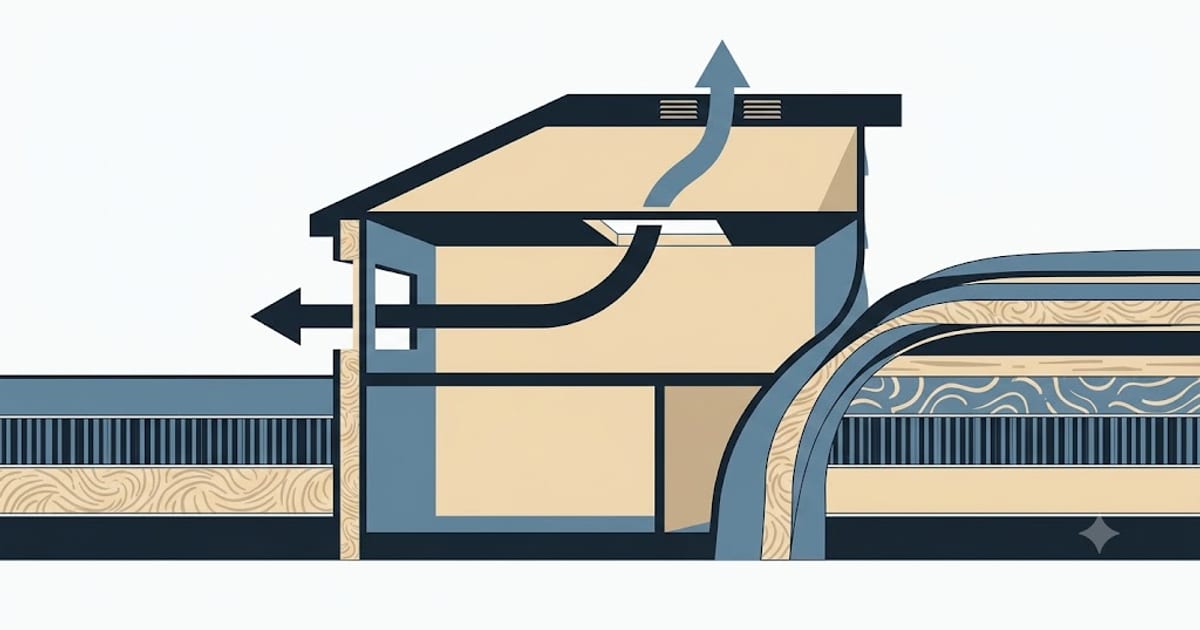
A whole house fan sits in the ceiling, pulls air out of the living space and pushes it into the attic, where it leaves through the roof vents. Open the windows, run it after sunset, and it exchanges the whole volume of the house several times an hour.
It is not an attic fan. An attic fan ventilates the attic. A whole house fan ventilates the house and uses the attic as its exhaust duct — which is why its venting requirement is so much larger.
What it costs
| Unit | Installed | |
|---|---|---|
| Traditional belt-drive, 30–36 in | $350–700 | $700–1,400 |
| Insulated ducted (R-value damper) | $700–1,600 | $1,200–2,600 |
| Added attic venting, if needed | — | $300–1,200 |
Running cost is where it earns its place: 200–700 watts against 3,000–5,000 W for central air. Eight hours of fan is roughly one hour of air conditioning.
Sizing it
The rule is air changes per hour, not floor area:
CFM = house volume (ft³) × air changes per hour ÷ 60
Three to six air changes per hour is the usual target — three in a mild climate, six where nights are barely cooler than days.
Worked example, 2,000 ft² house with 8 ft ceilings:
- Volume: 2,000 × 8 = 16,000 ft³
- At 4 ACH: 16,000 × 4 ÷ 60 = 1,067 CFM
- At 6 ACH: 1,600 CFM
The requirement that stops most installations
The fan has to push that air out of the attic. If the attic cannot pass it, the fan stalls against its own back pressure, moves a fraction of its rating, and pressurises the attic instead.
The manufacturer requirement is normally 1 ft² of net free attic vent area per 750 CFM, and some specify per 500.
For the 1,600 CFM example at 1:750: 2.13 ft², or 307 in² of net free area — and that is on top of the ventilation the attic already needs for its own sake under the 1/300 rule.
| House | CFM at 4 ACH | Extra NFA at 1:750 | Standard soffit vents |
|---|---|---|---|
| 1,200 ft² | 640 | 0.85 ft² (123 in²) | ~2 |
| 1,600 ft² | 853 | 1.14 ft² (164 in²) | ~3 |
| 2,000 ft² | 1,067 | 1.42 ft² (205 in²) | ~4 |
| 2,600 ft² | 1,387 | 1.85 ft² (266 in²) | ~5 |
Most attics do not have this spare capacity. Budget for adding vents as part of the job, not as a possibility.
The winter problem
A whole house fan is a large hole in the ceiling plane — the exact plane this site spends most of its time telling you to seal.
An uninsulated louvered fan is a permanent thermal bypass: warm air rises through it all winter, taking moisture into a cold attic. On a house where the attic has just been insulated to R-49, one unsealed 30-inch fan opening can undo a meaningful part of that.
Two acceptable answers:
- An insulated damper model. Motorised doors that close against a gasket and carry their own R-value, usually R-5 to R-22. This is what the price premium buys.
- A winter cover. A rigid insulated box or fitted cover installed over the louvers each autumn. Cheap, effective, and dependent on somebody actually doing it.
An uninsulated fan with no cover is a good reason not to fit one at all in a cold zone.
When it is worth it
- Nights that drop at least 10–15 °F below the daytime peak
- Low humidity — the fan brings outdoor air in with whatever moisture it has
- An attic with vent capacity, or a budget to add it
- A household happy to open and close windows on a schedule
Where those hold, it displaces a large share of the cooling season for a few hundred watts. Where nights stay warm and humid, it moves hot wet air through the house and the money is better spent on attic insulation and its payback.